


In Karachi Vice, Samira Shackle sets out to understand how violence, crime, and political power actually function in Karachi as daily conditions that shape ordinary lives.
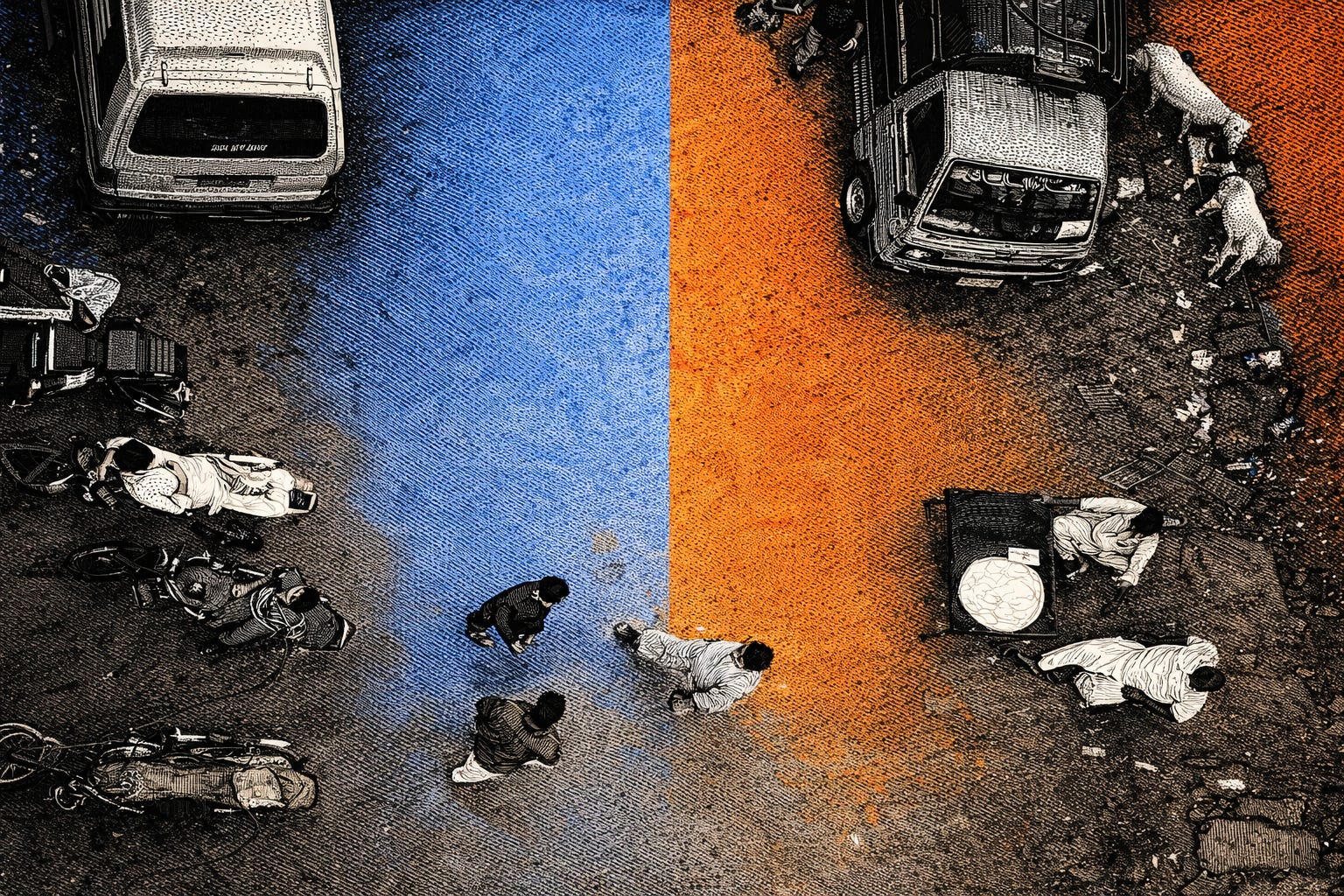
She is less interested in spectacular moments of terror than in the routines that make living with danger possible. She treats Karachi as a lens for understanding Pakistan more broadly, arguing that the city’s conflicts reflect national patterns of governance, inequality, and coercion.
She limits her focus to a specific period of intense violence and its aftermath, resisting the urge to turn Karachi into a timeless symbol of chaos. Instead, she asks how people adapt, endure, and make sense of a city structured by fear and negotiation.
Shackle organizes the book around the lives of five Karachi residents whose paths intersect during a violent crime wave. She moves between close, scene-based reporting and broader political and historical context, allowing individual experiences to carry structural arguments.
Early chapters ground the reader in Karachi’s geography, migration history, and political fragmentation. Later sections track how crime, sectarian violence, journalism, emergency services, and political parties overlap in practice. Throughout, she returns to the idea that violence is rarely random, showing how it is produced and managed through institutions, informal agreements, and silence. She uses her own position as a journalist with familykarachi ties to the city to navigate access, risk, and distance without making herself the center of the narrative.
Main Ideas Across the Book
Karachi’s violence is embedded in everyday systems rather than erupting as isolated breakdowns.
Political parties, criminal networks, and state institutions operate in overlapping and mutually dependent ways.
Ordinary residents learn to read invisible boundaries of safety, allegiance, and threat as a survival skill.
Crime reporting functions as both an exposure and a form of collaboration, constrained by intimidation and self-censorship.
Emergency responders and ambulance drivers operate as frontline witnesses to violence without the political power to change it.
Migration and rapid urban growth intensify competition over land, jobs, and resources.
Sectarian and ethnic divisions are repeatedly activated for political and financial gain.
The military and security services shape outcomes even when formally absent from the scene.
Corruption appears less as a moral failure than as a coping mechanism inside broken systems.
Moments of normalcy are actively constructed and defended by residents amid instability.
In the broader literature on urban violence, the author’s approach aligns with ethnographic and journalistic studies that focus on lived experience rather than policy prescription.
The book sits alongside reporting on cities like Rio de Janeiro or Lagos, where crime, politics, and inequality intersect at scale. It also contributes to conversations about Pakistan by complicating narratives that reduce violence to extremism alone. By centering Karachi, Shackle positions the city as a case study in how modern megacities absorb and normalize instability under weak governance.
My Notes
Karachi Vice is fundamentally about how violence in Karachi becomes ordinary without ever becoming fully visible. The highlights show a city split not just by class or ethnicity, but by perception. From insulated living rooms to contested streets, danger registers unevenly. The book tracks how political manipulation, crime, sectarianism, and urban neglect layer over time, producing a city where conflict feels both constant and abstract.
Patterns the Book Exposes
Karachi appears as a city of parallel realities, where affluent neighborhoods exist as sealed bubbles next to zones of daily warfare.
The book repeatedly frames violence as something that can feel unreal when viewed from a distance, reduced to numbers rather than lived experience.
Ethnic and sectarian divisions are shown not as organic chaos, but as forces repeatedly exploited by politicians and military rulers for leverage.
Migration and convergence keep resurfacing, with Karachi absorbing people from across Pakistan along with their unresolved rivalries.
Geography operates on two levels: the physical layout of roads and flyovers, and an invisible map of allegiances and danger.
Criminality is presented as intimate and embedded, especially in places like Lyari, rather than distant or faceless.
Journalism emerges as a careful negotiation with risk, where language is adjusted to avoid becoming a target.
Terrorism is treated less as a moral rupture and more as a technical problem for those tasked with covering or containing it.
Public piety and political symbolism repeatedly collide with private grief and hypocrisy.
State power shows up most clearly through absence, neglect, or brute force rather than protection.
Useful Contradictions
Violence is described as omnipresent, yet it often fails to register emotionally for those insulated by geography and class.
Terrorism is framed as an existential threat to society, but handled pragmatically by reporters as a matter of personal survival.
Political actors claim ownership over public suffering while ignoring individual dignity in moments of death.
Development is presented as progress, even when it proceeds without checking whether people are still inside the structures being destroyed.
Signals
Distance can turn ongoing violence into abstract data without reducing its intensity on the ground.
Cities accumulate conflict faster than they resolve it.
Power often expresses itself through selective visibility rather than direct control.
Language shifts first when fear enters a system.
Development that ignores human presence still counts as development on paper.
One Quiet Question
What does it mean to understand a city if its most dangerous realities only register when they cross into your own streets?
My Take
In Karachi, violence does not announce itself evenly. For some, it arrives as sirens, gunfire, and bodies in the street. For others, it appears as numbers on a screen, distant enough to feel unreal.
I would know. I was born in Karachi and lost my mamoo (maternal uncle) to sectarian violence.
Karachi Vice stays with that unevenness as Shackle writes about a city where danger is constant, but perception is fractured. And where knowing what is happening depends less on facts than on where you are standing.
Karachi Vice is built around how people learn to live inside that fracture.
Shackle follows several Karachi residents whose lives intersect during a period of intense violence and its aftermath. The book moves through close reporting and wider political context without turning either into spectacle. Karachi’s migration history, its political fragmentation, and its uneven urban development are treated as active forces rather than a backdrop. Violence is not framed as a series of eruptions, but as something anticipated and managed. People learn which routes are safe, which words carry risk, and when silence is a form of intelligence.
Across the book, Karachi emerges as a city of parallel realities.
Affluent neighborhoods function as sealed interiors where violence registers as alerts, statistics, and distant talk. A few miles away, other areas experience it as daily proximity. That distance turns danger into abstraction without diminishing its intensity on the ground.
Geography matters twice. There is the physical city of flyovers, choke points, and neighborhoods, and there is an invisible map of allegiances, ethnic boundaries, and threats that residents internalize.
Criminality is shown as intimate rather than faceless, especially in places like Lyari, where it is embedded in social life. Journalism appears not as heroic exposure but as careful negotiation. Language shifts first when fear enters the system. Terrorism, publicly framed as existential, is handled pragmatically by reporters as a technical problem tied to survival. State power is felt most clearly through absence, neglect, or sudden force, rather than steady protection.
What the book does exceptionally well is surface contradictions without forcing them into resolution.
Violence is omnipresent, yet often fails to register emotionally for those insulated by class and location. Political actors claim ownership over public suffering while individual dignity collapses in moments of death. Development is celebrated as progress even when it proceeds without checking whether people are still inside the structures being destroyed. Public piety and political symbolism sit uneasily beside private grief and hypocrisy. Shackle does not argue these tensions into submission. She lets them accumulate, which mirrors how cities accumulate conflict faster than they resolve it.
The book’s strength is its discipline.
By limiting its timeframe and resisting the urge to turn Karachi into a timeless emblem of chaos, it avoids moral spectacle. Shackle’s proximity to the city, including personal ties, allows access without pulling the narrative inward. The account of how violence becomes ordinary without becoming fully visible is precise and convincing. Where the book occasionally wobbles is in how distant ultimate leverage remains.
Military and security institutions shape outcomes even when they are formally absent, but they often stay just offstage. This feels deliberate, yet it leaves a faint sense of imbalance. The mechanics of adaptation are richly detailed. The sources of enduring control are harder to see.
This is a book for readers who want to understand how cities absorb instability rather than how to fix them. It will resonate with those interested in urban life, journalism under pressure, and Pakistan beyond the usual frames of extremism or crisis. And dare I say, Bollywood.
What the reader takes away is not a solution or a verdict, but a lens. One that makes it harder to mistake distance for safety, data for understanding, or development for care. The book leaves you clearer about what it means to know a city whose most dangerous realities only register when they finally cross into your own street.
Or when a beloved Doctor’s life is cut short in broad daylight.
On my damage meter, this clocked at 4. Gets under your skin.
Wonderfully said. Sounds like a striking look at the friction between Karachi’s hyper-modern aspirations and the gritty, 'grey-market' infrastructure that actually keeps the city running.
Your analysis of Karachi Vice gets to the heart of Samira Shackle's thesis: that the city isn’t just a setting, but a functioning organism that thrives on its own dysfunction. Most reviews focus on the grit of the reporting, but you’ve highlighted the structural entropy—the way the city's informal networks have stepped in to fill the vacuum left by a retreating state. It’s a compelling look at the 'parallel architectures' of power, where the line between a civic hero and a local strongman is effectively nonexistent. You’ve reframed the book from a series of character studies into a broader warning about the future of the megacity in the global south.