


I did not go looking for a theory about modern charity. I tripped over it in an Instagram ad.
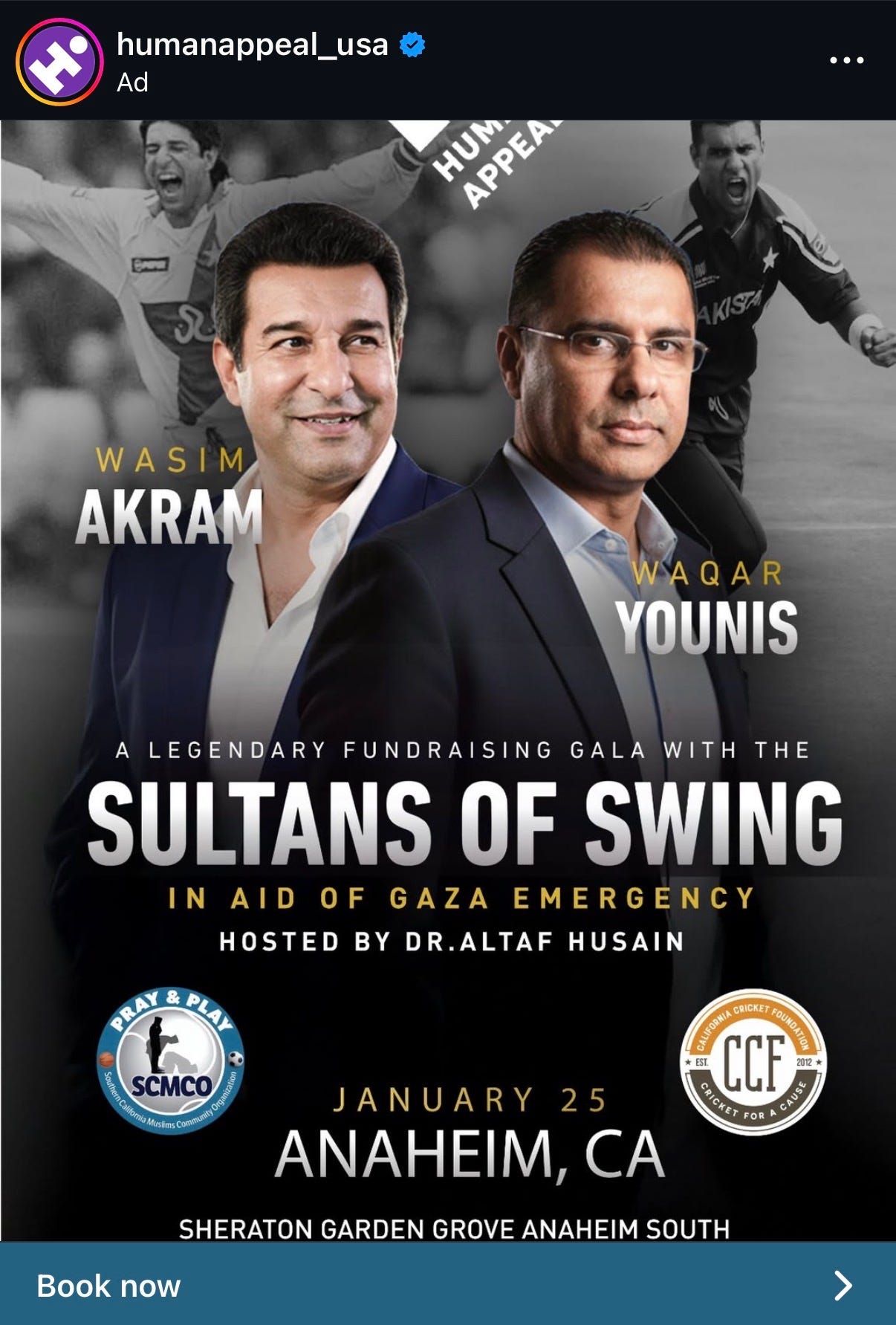
Human Appeal USA was promoting a black-tie cricket fundraiser in California. Wasim Akram. Waqar Younis. A formal dinner. Tickets starting at $65. A live auction.
My reaction was immediate and visceral.
Why is a humanitarian charity advertising on Instagram? Why are Pakistani cricketers headlining a U.S. nonprofit event that isn’t going to benefit Pakistan? Why does aid for a war zone arrive wrapped in celebrity, banquet halls, and paid social media?
The instinctive answer is moral discomfort. The accurate answer is structural reality. I guess.
Human Appeal is not a Pakistani charity. It is a U.S.-registered nonprofit operating inside the American attention economy. And in that economy, suffering does not circulate on its own. It must be carried, framed, and promoted. Compassion doesn’t automatically translate into donation, it competes with numerous other charities.
Instagram is not beneath charity. It is where donors live now. Cricket is not incidental. It is a cultural trust bridge into a diaspora that gives, gathers, and shows up. A gala is not automatically indulgent. It is one of the last environments where people can be made uncomfortable together, where generosity becomes visible and contagious.
This is not a defense. It is a description of the terrain. I was the specific target for this ad. And that bothers me because I will never attend such an event or ever look at the people involved with this event the same way. Even the two Ws.
But terrain does not absolve execution. Because not all charity events are equal, and not all celebrity-driven fundraisers deserve the same benefit of the doubt.
The entire moral and financial weight of the Human Appeal cricket tour rests on a single question the promotional materials never answer.
Who gets paid first?
At the surface level, the math appears harmless. $65 tickets. Discounted tables. Auctioned memorabilia. A fundraising appeal layered into dinner. But ticket sales are rarely the point. They barely cover the meal. The real money is supposed to come from sponsors, auctions, and the moment when the room watches itself give.
That model only works if the spectacle is donated.
If the cricketers are donating their presence, the economics hold. The event becomes a lever. Attention converts into aid. Overhead exists, but it is bounded. The compromise is visible and defensible.
If the appearances are modestly paid, the event drifts into ambiguity. It may break even. It may generate mailing lists, social proof, and content. But the cause itself advances only marginally. The night sustains the organization more than it serves the mission.
If the celebrities are paid at market rates, the illusion collapses. Then the fundraiser is no longer a mechanism for aid. It is a transfer. Donor money flows upward to fame and production before it ever touches relief. Gaza becomes a justification rather than a beneficiary.
This distinction matters because modern charities borrow the aesthetics of commerce without consistently adopting its transparency. We are shown impact photos. We are given aggregate totals. We are rarely shown net proceeds. We are told about awareness as if awareness feeds people.
Awareness is not an outcome. It is a cost.
Human Appeal is not uniquely guilty of this dynamic. It is representative. A professionalized nonprofit navigating capitalism while still asking to be judged as if it operates outside it. That tension now defines the sector.
The discomfort people feel when they see a charity advertising on Instagram or hosting a gala is not naïveté. It is an intuition that something sacred has been priced. That intuition is not wrong. But it is incomplete.
The problem is not that charity has entered the attention economy. That argument is already over. The problem is that attention has become expensive, and the bill is rarely itemized.
If Human Appeal wants this model to be trusted, the fix is simple and brutal. Publish the numbers. Not the glossy totals. The net. Cost per dollar raised. Whether celebrity appearances were donated or paid. Whether sponsors underwrote the room or donors did. Who absorbed the risk if the night underperformed.
Charity does not lose legitimacy when it markets itself. It loses legitimacy when it asks for faith instead of math.
I stumbled onto a test case. One that says less about one organization than about the world we have built. A world where even mercy must compete for reach, where generosity is mediated by algorithms, and where the real moral line is no longer how loudly a charity asks, but how honestly it accounts.
The only radical act left is showing the receipts.